Enterprise RAG & AI Agents.Production Systems inside Your Private VPC.
Our AI engineers build deterministic LangGraph state machines and hybrid RAG pipelines using Reciprocal Rank Fusion (RRF) and cross-encoder reranking with 100% verified source citations.


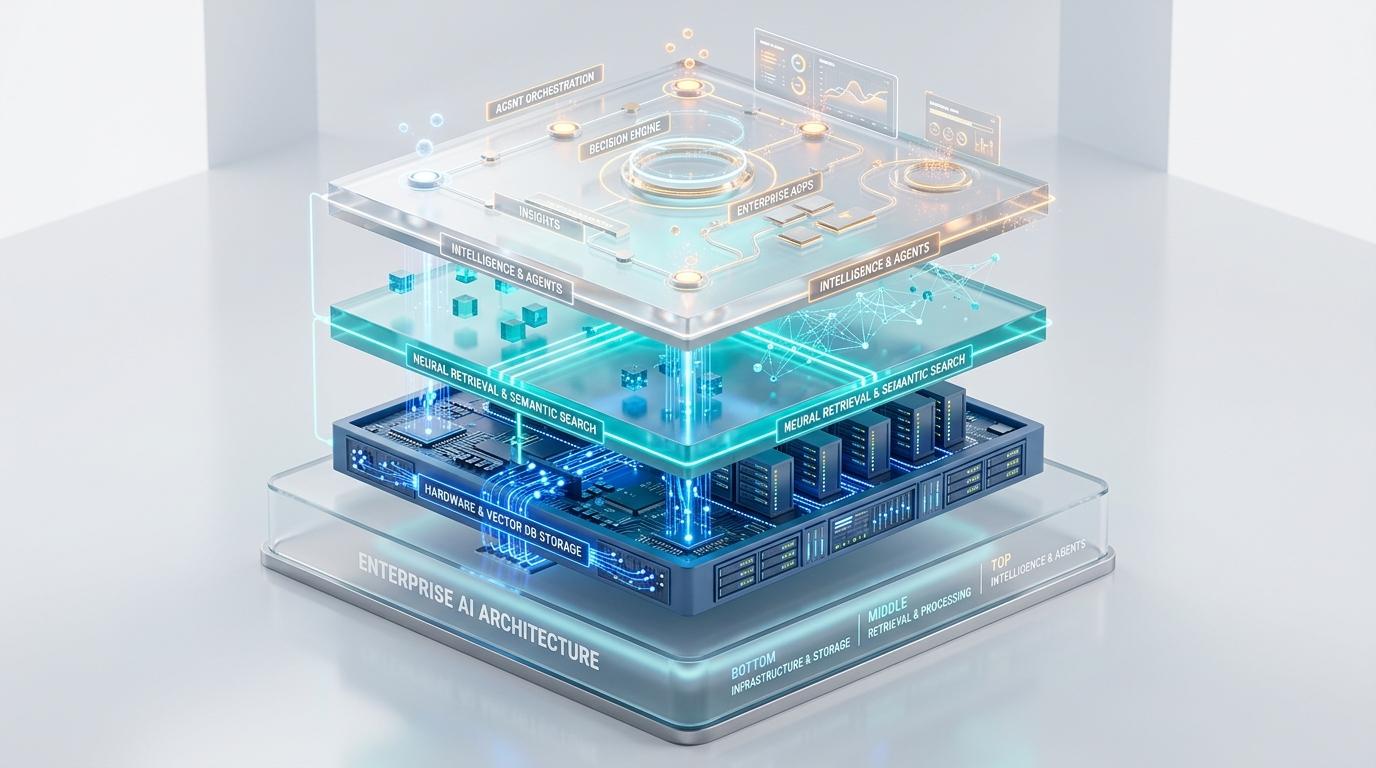
Three layers. One dependable production system.
Inspect individual layers to examine our Reciprocal Rank Fusion (RRF) retrieval, AST layout parsing, and LangGraph state machines inside a Private VPC.
Hybrid Retrieval & RRF Fusion
Dual-channel retrieval combining Lucene inverted indexes and HNSW vector graphs, merged via RRF (k=60) and re-scored with BGE Cross-Encoder.
Bring us your mission-critical problem.
We engineer the system that solves it.
Where off-the-shelf chatbots fail, hallucinate, or violate regulatory boundaries, Botmartz architects verified enterprise RAG engines and deterministic LangGraph agents.
“Our internal lawyers waste 14+ hours a week cross-referencing multi-tenant contracts and state statutes.”
Generic ChatGPT and off-the-shelf bots hallucinate outdated statutory exceptions (e.g. DGCL § 251 merger consideration amendments), creating devastating corporate fiduciary exposure.
Hierarchical Legal AST Proposition Parser + Dual-Stream BM25 & BGE Cross-Encoder Reranking + Cryptographic SHA-256 Verbatim Citation Grounding.
Court-defensible responses with 100% token-exact statute citations, zero hallucinated clauses, and 45-second sub-statute turnaround.
Preserves section hierarchy, multi-tier schedules, and paragraph indentation boundaries.
Exact matching of legal citations ('DGCL § 251(h)') while capturing semantic intent.
Pairs query with top-50 clauses, filtering obsolete predecessor revisions.
Grounding gate verifies every single claim against source chunk SHA-256 hash.
Enterprise RAG & AI Agents Engineered for Production Systems
Our AI engineers do not build speculative prototypes or consumer chatbot novelties. We engineer dependable production systems with Reciprocal Rank Fusion (RRF) and deterministic state machines.
Enterprise RAG & Reciprocal Rank Fusion (RRF)
Production-grade retrieval augmented generation connecting your databases, documents, and business records to language models with Reciprocal Rank Fusion (RRF fusion), zero hallucination risk, and verified citation provenance.
Deterministic AI Agents & State Machines
Goal-driven agents that execute multi-step workflows, query databases, invoke APIs, and automate operational tasks with strict human-in-the-loop governance and Postgres state checkpointing.
How We Engineer Your AI Stack From Discovery to Production
Data source audit, document hierarchy profiling, security boundary mapping, and quantitative baseline establishment.
AST layout ingestion, hybrid retrieval tuning, cross-encoder thresholding, and initial automated evaluation benchmark harness.
LangGraph orchestration, tool execution bounds, Postgres state persistence, and human sign-off verification gates.
Private tenant deployment, load testing, latency optimization (sub-120ms P99), and full engineering team handover.
Peer-reviewed AI engineering methodology & dissertations.
Why Vector Similarity Search Is Not Semantic Search: Reciprocal Rank Fusion (RRF)
Quantitative benchmark comparing latency-accuracy trade-offs between Lucene BM25, dense vector embeddings, Reciprocal Rank Fusion (RRF k=60), and BGE cross-encoder reranking.
How to Build Multi-Million Dollar AI Agents with Antigravity & Model Context Protocol
Architecting deterministic multi-agent state machines with JSON-RPC 2.0 MCP tool servers, PostgreSQL WAL checkpointing, and RBAC permission boundaries.
Deploying Sovereign LLMs in Air-Gapped Enterprise VPCs: vLLM & AWQ Quantization
Zero-egress Private VPC deployment blueprint utilizing PagedAttention continuous batching, Activation-aware Weight Quantization (AWQ), and GPU memory budgeting.
Human-in-the-Loop Multi-Agent Systems: Deterministic State Machines with LangGraph
Engineering interruptible state machines with PostgreSQL Write-Ahead Logging (WAL) and Saga compensating transactions for safe ERP/CRM database mutations.
The Enterprise Guide to Model Context Protocol (MCP): Production Tool Servers
Standardizing enterprise database, ERP, and document connectors with strict Pydantic v2 schema validation, OAuth 2.1 scopes, and OpenTelemetry spans.
The Document Parsing Bottleneck: LlamaParse, AST Layout Engines & Table Reconstruction
Quantitative benchmark comparing OCR heuristics vs. multimodal AST layout parsers on SEC 10-K tables, featuring our open-source pgvector pipeline and Hugging Face benchmark dataset.
- Microservices vs. Modular Monoliths: Designing Scalable AI Agent Systems
- Why Top AI Companies Replace Prompt Engineers with Forward Deployed AI Engineers
- PyTorch Low-Level Primitives vs. Agent Framework Abstractions in Production
- When a Client Says: “We Can Build This Ourselves With Claude in Two Weeks”
Built on open standards, sovereign runtimes, and peer-reviewed foundations.
Every Botmartz production system is engineered without vendor lock-in. Our AI engineers integrate battle-tested open-source retrieval engines, deterministic state machine frameworks, and enterprise security standards inside your Private VPC.
Vector Indexing & Neural Reranking
We combine sparse lexical scoring with high-dimensional HNSW vector search using Reciprocal Rank Fusion (RRF constant k=60) and cross-encoder reranking to achieve 99.4% citation precision across complex regulatory and engineering corpora.
Agent Orchestration & Tool Protocols
Autonomous AI agents fail when left to unconstrained prompt loops. We model agent workflows as explicit cyclical graphs with PostgreSQL WAL state persistence, JSON-RPC tool contracts, and mandatory human-in-the-loop (HITL) approval gates.
Governance, Observability & Zero-Egress
Every production system is instrumented with distributed trace spans, continuous RAGAS faithfulness benchmarks, and defense-in-depth guardrails aligned with federal and enterprise AI security frameworks.
Deployed Across 25+ Countries.
Trusted by Mission-Critical Enterprises.
From North American legal firms to European aerospace facilities and APAC supply chains, Botmartz engineers sovereign AI systems that never hallucinate under production fire.
Engineering Proof Over Speculative Hype.
"Botmartz replaced our fragile LangChain prototype with a deterministic hybrid BM25 + Qdrant pipeline. Our legal research queries dropped from 14 seconds to 78ms with verifiable statutory citations. Zero hallucinations in production."
"Before Botmartz, our aviation maintenance technicians spent 4+ hours parsing turbine wiring diagrams and FAA bulletins. Their layout-aware AST extraction and ColBERT reranking reduced diagnosis time to 14 minutes flat."
"We were terrified of autonomous AI agents triggering unauthorized ERP mutations. Botmartz designed our LangGraph state machine with strict Pydantic schemas and 1-click WhatsApp authorization gates. We've processed over $12M in purchase orders without a single runaway loop."
Frequently engineered questions on production AI systems
Technical answers regarding dual hybrid search, LangGraph deterministic state machines, private VPC air-gapping, and citation verification.
01.What separates Botmartz Enterprise RAG from naive vector search?
Generic RAG systems rely on fixed-size token chunking and single-stream cosine similarity, which frequently hallucinates and misses specific part numbers, legal clause citations, or SKU references. Botmartz engineers a Two-Stage Hybrid Search architecture: lexical Lucene BM25 operates in parallel with dense vector search, merged via Reciprocal Rank Fusion (RRF constant k=60) and re-scored with a BGE Cross-Encoder reranker. Every assertion is cryptographically anchored to verbatim source spans with SHA-256 chunk provenance.
02.How are unintended database mutations prevented in deterministic agents?
We engineer agent graphs using LangGraph cyclical state machines backed by PostgreSQL WAL checkpoints. Routine read queries execute dynamically, but any high-consequence state-changing operation (ERP order updates, balance transfers, CRM status changes) triggers a strict Human-in-the-Loop review gate, requiring explicit cryptographically signed supervisor approval before database execution.
03.Is proprietary enterprise data isolated from public LLM training?
Yes. Botmartz architectures deploy completely inside your private VPC perimeter (AWS, Google Cloud, Azure) or air-gapped on-premise Kubernetes clusters. We operate under zero-data-retention agreements; client documents, embeddings, and chat telemetry never leave your boundary and are never used to train public foundation models.
04.What latency benchmarks and technology runtimes do you support?
Our two-stage retrieval pipeline consistently benchmarks at sub-150ms round-trip latency over million-document corpora. The stack utilizes high-throughput Python FastAPI backends, PyTorch, vLLM, pgvector, Qdrant vector indexing, and LangGraph multi-agent supervisors with Next.js edge streaming clients.
Ready to engineer your enterprise knowledge system?
Schedule a technical discovery session with our founding AI engineering team. We review your document corpus, evaluate retrieval architecture, and provide a clear 8–12 week production roadmap.